PharmSci 360 begins on November 3. Don’t miss out on great science and more!
By Dale Eric Wurster, Ph.D., FAAPS, President

Throughout this year, I have spoken frequently about science. I mentioned the AAPS journals that cover a wide range of pharmaceutical topics. I encouraged members to share their research by presenting a poster and shared a survey of poster presenters. I pointed out how members are actively discussing science and sharing resources on the AAPS Communities. And I shared how members contribute to scientific knowledge via AAPS’ many platforms: workshops, elearning, and periodicals. However, our biggest opportunity for scientific exchange is finally here: the 2019 AAPS PharmSci 360. All of us at AAPS—volunteers, leaders, and staff—cannot wait to get this year’s program up and running.
At PharmSci 360, the science of both chemical and biomolecular entities will be evenly covered in their own separate five tracks:
- Preclinical development
- Bioanalytics
- Clinical pharmacology
- Manufacturing and bioprocessing
- Formulation and quality
These tracks have been designed to give this large scientific conference the content depth of a small, focused gathering. Whether you are interested in small molecules, biologicals, or both, we have built these tracks for your needs. Each track will contain scientific symposia in various themes with specialized keynote speakers.
In addition, two end-to-end topics will cover the entire drug development process in two areas:
- Biomolecular: Nucleic Acid-Based Therapeutics: Discovery, Development, and Delivery
- Chemical: The Journey to Developing Tissue- and
Organ-Specific Therapies
You can concentrate on your scientific track all week or follow one of these end-to-end topics and develop a broad understanding of these hot topic issues that touch on each track.
For those focusing on a particular track, mornings will begin with a 30-minute prologue for each track outlining the scientific program focus for that day. You can then spend the rest of the morning either in scientific symposia—choosing the chemical or biomolecular path—or in one of the end-to-end hot topic sessions. See what sessions address your area of interest in the chemical or biomolecular subtrack in this issue’s program preview or in the meeting app.
If you want to start your meeting early, preconference workshops and short courses start on Sunday, November 3. This year they focus on statistical thinking; chemistry, manufacturing, and controls challenges; patient-focused drug development; parenterals; mechanistic modeling and simulation; nucleotide-based therapeutics; cell and gene therapies; biomarker methods; and translational pharmacokinetics/pharmacodynamics and first-in-human studies for novel modalities. Read more about these science sessions in this issue’s Programming Preview under Cover Stories.
We have expanded the scientific and career programming in the Solution Center. Be sure to include time to take part in some unique educational opportunities:
- Rapid Fire presentations are back by popular demand. Starting at 3 pm every day, each track will feature a series of 10-minute, informal, innovative presentations. Check the app for full details.
- Tech Challenges will showcase new and innovative technologies in a peer competition. The top-voted technologies will face off on Wednesday.
- The Software Lab will be a hands-on, interactive session as companies demonstrate their latest software.
- Partner Presentations will feature case studies and speaker panels and take questions about products and services.
- The Career Development Classroom will focus on strategic leadership, managing your career in a rapidly changing world, and working with other organizations. Learn more about career development sessions in the Career Success section.
- The Career Center will feature company recruiters, private interview rooms, a free LinkedIn profile critique, résumé reviews, and a professional headshot lounge. Learn more about the Career Center in the Career Success section.
Exhibiting partners will be divided into neighborhoods that mirror the five program tracks. Each neighborhood will have poster forums and other areas specifically dedicated to their track. You can see the latest technologies and find scientists and representatives with expertise relating to your field.
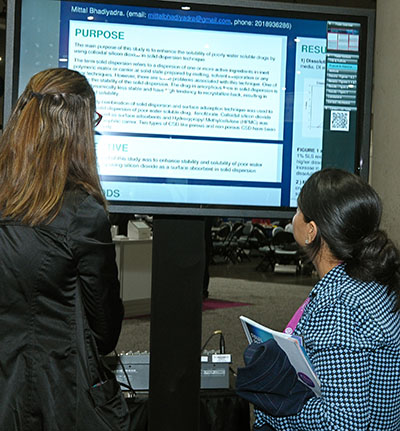 Once again, posters will be grouped by topic into intimate poster forums related to the meeting tracks in the appropriate neighborhood of the Solution Center. AAPS has monitored the performance of the posters closely in recent years, and we have used that feedback to make the poster experience rewarding for both presenters and attendees. We have designed the poster forums to generate conversations that can lead to deeper understanding and expanded networks.
Each poster forum will have multiple posters geared to a particular topic, so you can easily see what is new and ask questions. Authors will have specific screen locations for a full hour. However, the poster terminals in the forums will be freely available until 9:30 am, so you will have an hour each morning to use any screen to browse the poster catalogue. We will also have the Poster Café, where attendees can look up any poster at any time.
Keynote speakers will speak every day between 1:30 and 2:30 pm on topics relating to the five tracks. Starting at 3 pm each day, Rapid Fire Presentations will once again cover new and exciting ideas. Rapid Fires allow scientists to talk about anything—including data that is not ready for publication, big ideas, interesting insights, and even failures. These presentations have enabled diverse scientific knowledge exchange, triggered innovation, and promoted networking. Each presentation will last 10 minutes and take questions for three minutes, so be ready to learn something new!
For Sunday’s opening plenary session, I am pleased to report that Peter Agre, M.D., Bloomberg Distinguished Professor and director of Johns Hopkins Malaria Research Institute will speak. Agre’s research focuses on molecular aspects of human diseases, including hemolytic anemias, blood group antigens, and malaria. He received the 2003 Nobel Prize in Chemistry for discovering the aquaporin water channels.
The closing plenary on Wednesday, Nov. 6, will feature Vivek H. Murthy, M.D., M.B.A., 19th Surgeon General of the United States, and Katherine A. High, M.D., president, Spark Therapeutics, a hematologist with an interest in gene therapy for genetic disease. Immediately afterwards is the closing reception, where you can socialize with colleagues and discuss the science most relevant to your work and what you will put into practice back in the workplace.
Read more about PharmSci 360 in this issue’s program preview and on the meeting app, where you can browse the schedule by track, session type, or keyword; the Solution Center by company, track, booth number, or floorplan; networking activities by philanthropy, reception, affiliate event, or community social; or speakers.
This meeting’s success rests on the hard work of our AAPS volunteers and staff. Thank you for all your hard work and your support to make the 2019 AAPS PharmSci 360 a success.
I look forward to seeing you in San Antonio!